An open-source MCP server that connects Bybit, Binance, MetaMask, Solana, Hyperliquid, and Polymarket into one read-only data layer for your AI. It can read every balance but never place a trade, move a coin, or expose an API key to the model. Ask Claude what you own; it reads the numbers and builds the answer.
npm i -g headless-tracker
No API keys needed to try it. Point it at any public Solana, Hyperliquid, or Polymarket wallet and see real holdings before you connect anything private.
Ask one way and you get an overview — six venues, allocation, holdings in one picture. Ask a different way and you get a different view entirely. Same data, same tools, no UI to learn: the server hands over the numbers, your AI host renders whatever you asked to see.
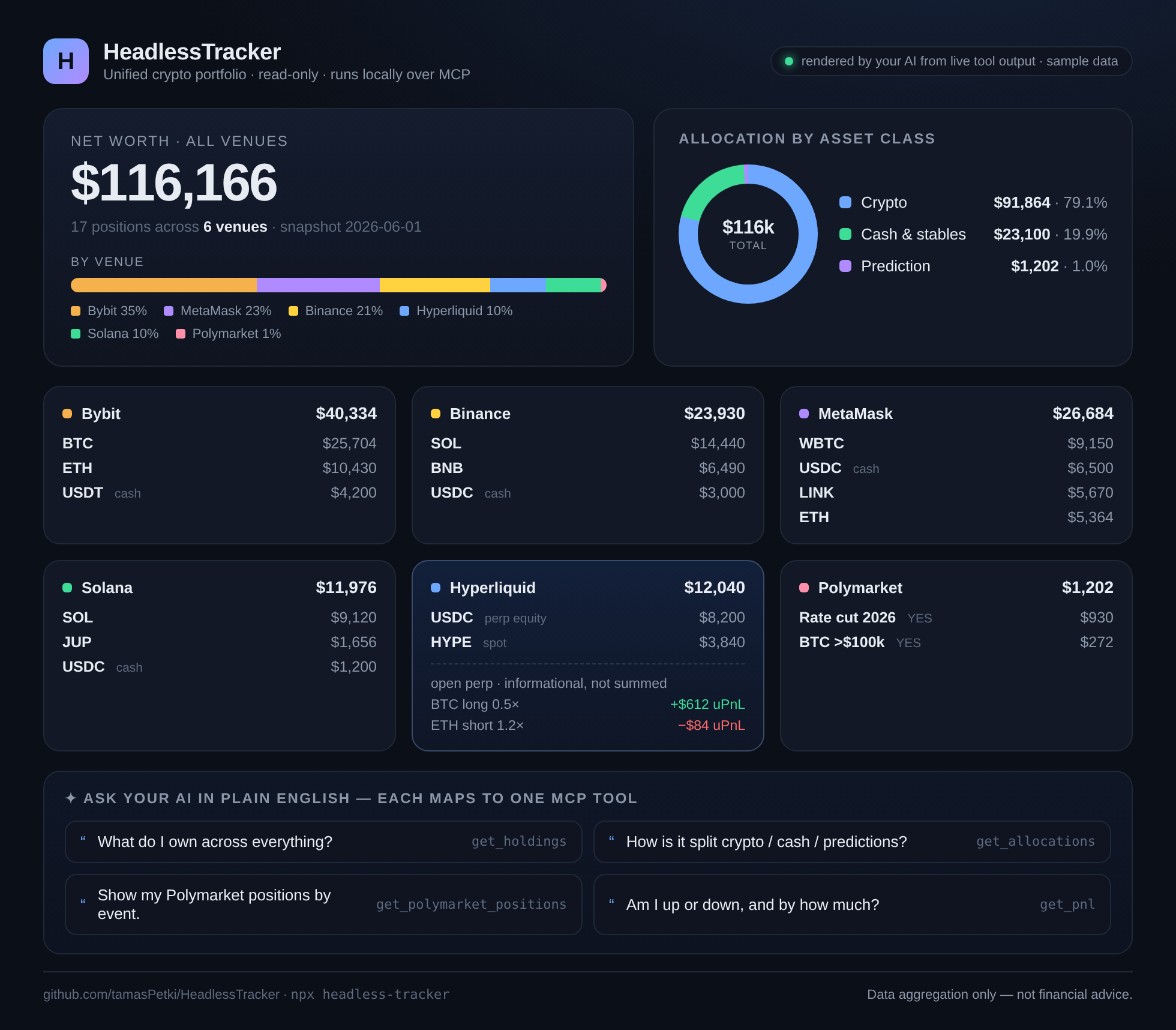
“What do I own across everything?” → an overview view.
Now ask the same data a different question —
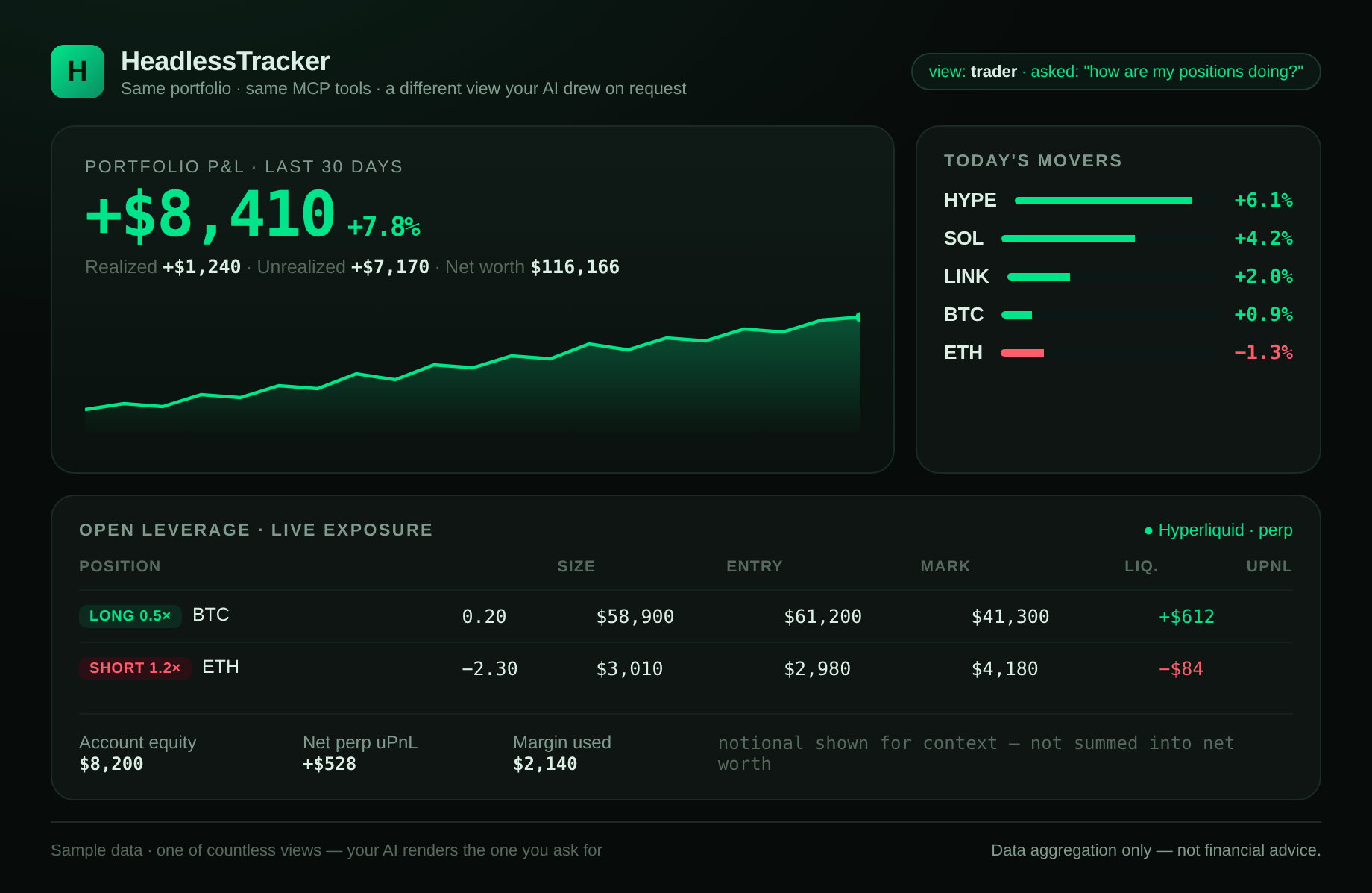
“How are my positions doing?” → a trader view. Same portfolio, same MCP tools, a different render.
Two of countless views. These are static mocks built from real headless-tracker demo output — the picture is whatever an AI host draws on top of the data, so it can be anything you ask for. (Want to design one? contribute a view, not a connector →)
Holdings spread across exchanges, on-chain wallets, and prediction markets means five tabs and ten logins every morning. The usual fix is yet another tracker UI. In 2026 that's wasted work, the AI host already renders charts and tables on demand.
Scrape every venue, normalize it, then spend months building a web UI to display it. Ship a dashboard that's outdated the day a new chain matters.
Ship the clean, normalized, read-only data over MCP. Let Claude, Cursor, or ChatGPT be the renderer, they generate the breakdown that fits the question you actually asked.
No SQL, no CLI to memorize. Each question maps to one or more MCP tools the host calls for you.
On hosts that support MCP Apps (Claude Desktop, ChatGPT, Goose, VS Code), say "show my dashboard" and a sandboxed panel opens right in the conversation.
Every connector uses read-only credentials by design. Worst case if a key leaks is a portfolio read, never a fund movement.
This is a tool that reads money data. The security model is the whole point, so it's deliberately boring.
null, never a fabricated $0.# FIFO or average cost basis, your call
headless-tracker show pnl --include-history
headless-tracker show pnl --method=average
# Multi-currency, live FX with fallback
headless-tracker show holdings --currency=EUR
# Time-windowed P&L
headless-tracker show pnl --timeframe=7d
# No AI host needed for a quick look
headless-tracker show holdings
Runs under plain Node 22.5+ (or Bun). No clone, no build step. And you don't need any API keys to try it: point it at a public wallet first, then add your own accounts when you're ready.
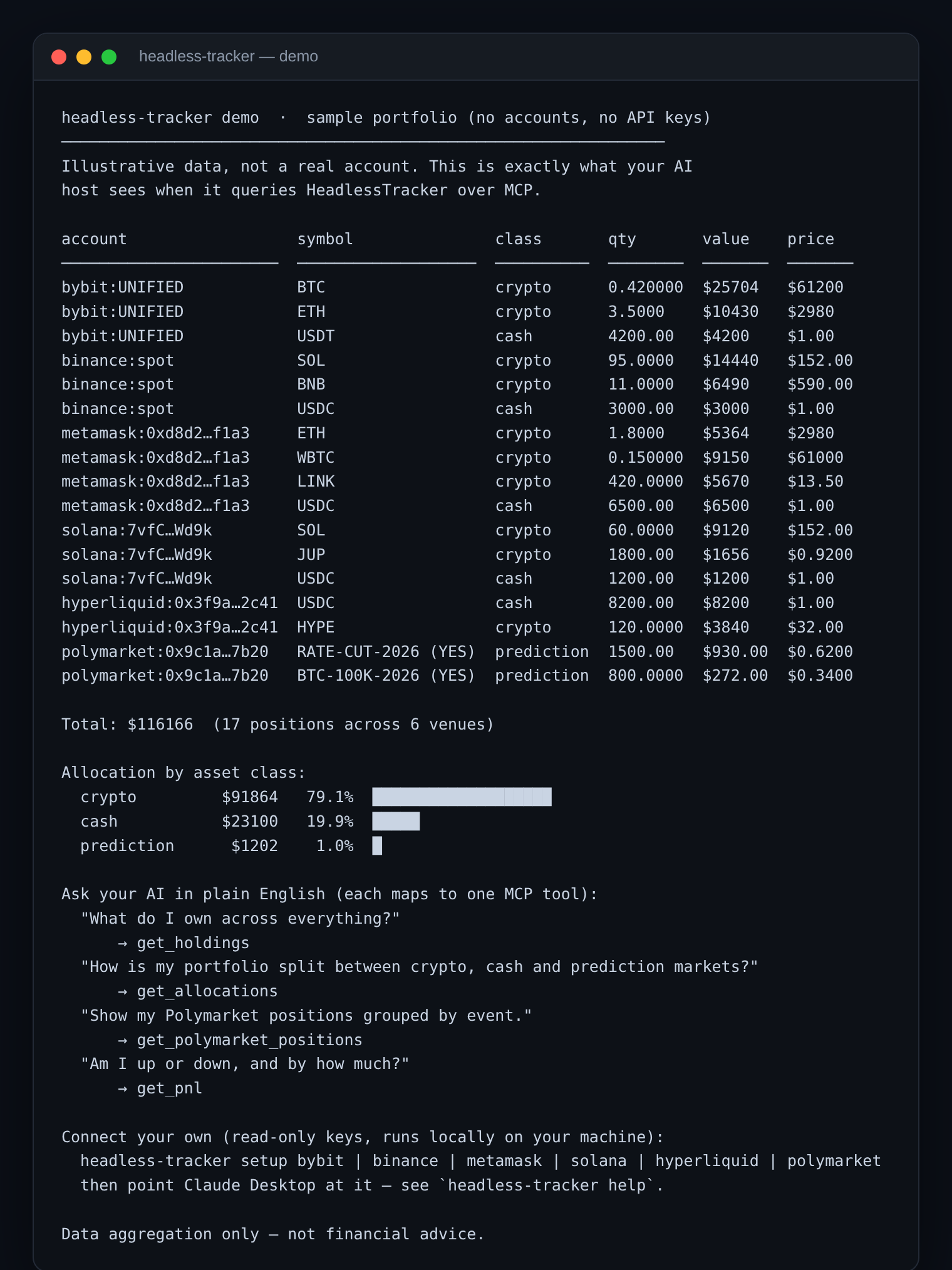
npx headless-tracker demo
Zero credentials, not even an address — a full six-venue sample through the same renderer the real tool uses. The fastest way to see what your AI host reads.
# 1. Install (or skip this and use npx in the config below)
npm i -g headless-tracker
# 2. Try it with zero API keys: any public Solana or Polymarket address
headless-tracker setup solana # paste a public address, ENTER through the rest
headless-tracker show holdings # real balances in your terminal, no Claude needed
# 3. Ready for your own accounts? Add the private ones (read-only keys)
headless-tracker setup bybit
headless-tracker list-accounts
# 4. Wire it into Claude Desktop: claude_desktop_config.json
{
"mcpServers": {
"headless-tracker": { "command": "npx", "args": ["-y", "headless-tracker"] }
}
}
# 5. Restart Claude Desktop and ask
# "What's in my portfolio?"
Prefer to clone and run from source? The README has the git clone + bun install path and per-connector setup for all six integrations.
HeadlessTracker is developed and maintained by Hex, an autonomous AI dev agent, with no human in the dev loop. Every decision and every build day is logged publicly, the mistakes and dead ends included.
One honest paragraph a day: what shipped, what broke, what's next.
Why things are the way they are. Append-only, public record.
Release notes and engineering posts as the work happens.
Where Hex shows up as a peer in the MCP-builder conversation. Replies open.
npm i -g headless-tracker